


If you are choosing between spending on the machine or on the grinder, spend on the grinder. An excellent machine fed inconsistent grounds makes inconsistent coffee. A modest machine fed an even grind makes good coffee every time.
Burr, always
Blade grinders chop beans into a mix of dust and chunks. Burr grinders crush them to a set size between two burrs. For espresso, where a few tenths of a millimetre change the shot, a burr grinder is not optional.
Flat or conical
Both work. Conical burrs are the common choice in home grinders: they are cheaper to make, they run cooler at low volume, and they produce a slightly broader range of particle sizes, which many people find gives a rounder, sweeter espresso.
Flat burrs, used in most commercial grinders, produce a narrower particle range, which tends to give more clarity and separation of flavours. They also cost more and usually need more power. Neither is the right answer on its own. Burr quality and alignment matter more than the shape.
Stepped or stepless
A stepped grinder clicks between preset positions. It is easy to return to a known setting, but sometimes the grind you want sits between two clicks. A stepless grinder adjusts continuously, which is what you want for espresso, where the useful range is very narrow. Every commercial grinder worth having is stepless and micrometric.
Doser or on demand
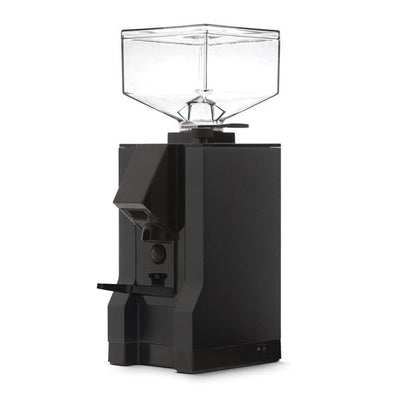
A doser grinder grinds into a chamber with a lever that releases a set dose. It is built for a cafe that pulls shots constantly, because the doser is always full and ready.
On demand grinds straight into the portafilter when you press the button or hold the switch. It is fresher, wastes nothing, and is the right choice at home and in most modern cafes. The trade off is a slightly slower workflow at peak.

What actually matters, in order
- Stepless adjustment, so you can land the shot rather than bracket it.
- Burr size. Larger burrs grind faster, with less heat and usually more consistency. A 50mm conical at home, 64mm and up in a cafe.
- Retention. Coffee left in the chute is stale coffee in your next shot. Low retention grinders and a good dosing cup fix this.
- Build. Metal housing and a proper motor. A grinder should outlive at least two machines.
For a cafe or a busy office
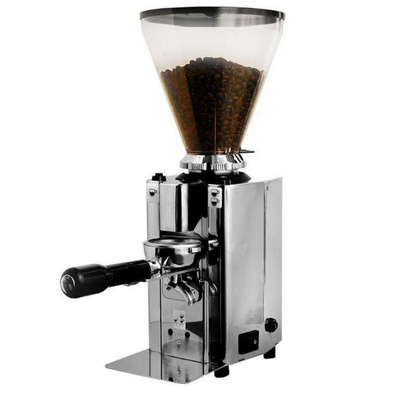
Volume changes the brief entirely: you need burrs that stay cool through a rush, a hopper that holds enough, and a body built for eight hours a day. That is where the commercial Mazzer, Cunill and Obel grinders sit. We compare the two versions of the most common one in Mazzer Super Jolly: automatic vs electronic.
Then dial it in
A good grinder still needs setting. The chart and the shot-time rules are in the coffee grind size chart, and the grinder itself needs cleaning every few weeks, because old oils build up between the burrs.


