


Decaf has a bad reputation and it is mostly deserved, but not for the reason people think. The problem is not removing the caffeine. It is what most producers use to remove it.
How decaf coffee is made: four ways to take caffeine out
Solvent based, direct and indirect
Green beans are treated with methylene chloride or ethyl acetate, which bond to caffeine and carry it away. It is cheap and it is the most common method in the world. It also strips out flavour compounds along with the caffeine, which is why so much decaf tastes flat and papery.
The residue left behind is regulated and considered safe. Taste is the real objection, not safety.
Carbon dioxide
CO2 under pressure behaves as a solvent that targets caffeine fairly selectively. Good results, expensive equipment, mostly used for large commercial volumes.
Water process
This is the one worth seeking out. Beans soak in water already saturated with everything soluble in coffee except caffeine. Because the water is full of coffee solubles, nothing else has anywhere to go, so only the caffeine leaves. No solvents at any stage.
You will see it as Swiss Water or, in our range, Mountain Water, which uses glacial meltwater from Pico de Orizaba in Mexico. Same principle.
How much caffeine is left
Decaffeination removes about 97 to 99.9 percent. A decaf cup carries roughly 2 to 7mg of caffeine against 80 to 100mg in a regular double shot.
So decaf is not caffeine free. Ten cups of decaf is roughly one regular coffee. For most people that is irrelevant, but if you are highly sensitive or told to avoid caffeine entirely, it is worth knowing.
Why decaf goes stale faster
Decaffeination is hard on the bean. It swells, softens and becomes more porous, so it stales faster than a caffeinated bean and it roasts differently, browning quicker and giving the roaster less margin for error.
Two practical consequences. Buy decaf in smaller amounts and more often. And buy it ground to order, because pre-ground decaf sitting on a shelf is the worst version of an already fragile product.
Where decaf came from
Decaf was an accident. In 1903 a shipment of coffee beans was soaked in seawater in transit, and the merchant Ludwig Roselius found the caffeine had largely leached out while much of the flavour survived. He patented a process using benzene, which we now know is carcinogenic and which nobody has used for a very long time.
The water process arrived in Switzerland in the late 1970s, and it is still the reason good decaf exists at all.
Who actually drinks it
The stereotype is people who cannot handle caffeine. In practice the biggest group is people who love coffee and want a third or fourth one without lying awake at two in the morning.
Caffeine has a half life of about five to six hours, so a 3pm coffee still has roughly half its caffeine working at 9pm. If you drink coffee late and sleep badly, decaf after lunch is the single easiest fix.
The others are people advised off caffeine during pregnancy or for blood pressure, people on medication that interacts with it, and anyone with reflux or anxiety who wants the ritual without the jitters.
Three myths
Decaf is chemically drenched. Solvent processes leave residues far below safety limits, and water process uses none at all. If it still bothers you, buy water process and the question disappears.
Decaf has no caffeine. It has a little, roughly one fortieth of a normal cup.
Decaf cannot taste good. Bad decaf is a sourcing decision, not a law of nature. Producers historically sent their worst lots to be decaffeinated because they assumed nobody would notice. Water process specialty decaf starts with good coffee and stays good.
Half caf
If you are cutting down rather than cutting out, blend decaf with your normal beans in the hopper. Fifty fifty halves your intake and, with two coffees from the same roaster, tastes almost identical to the full strength version. It is a far easier transition than going straight to decaf and deciding you hate it.
Brewing it
Decaf beans are more brittle, so they produce more fines at the same grinder setting. If your decaf espresso is running fast and sour, go slightly finer than you would for the caffeinated version.
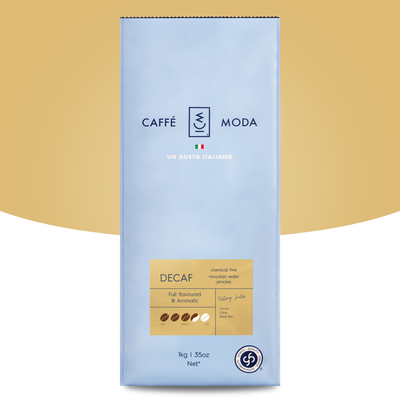
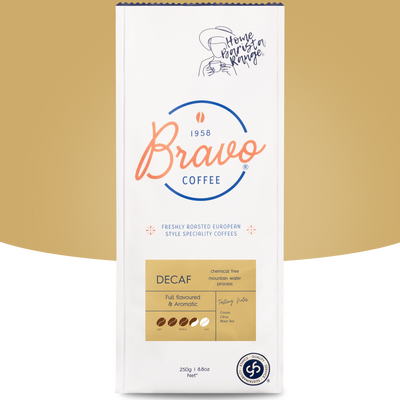
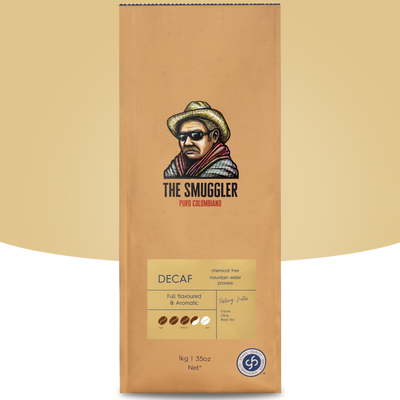
Our decaf range is mountain water process across the board, four blends from Caffe Moda, Bravo, The Smuggler and Calima. The decaf guide covers which one suits which brew method.
Our mountain water decafs
Every decaf we sell is mountain water process. No solvents, so the cup keeps its body.
Common questions
Does decaf coffee have caffeine?
A little. Decaffeination removes about 97 to 99.9 percent, so a decaf cup carries roughly 2 to 7mg against 80 to 100mg in a regular double shot.
What is Swiss Water decaf?
A water process: beans soak in water already saturated with everything soluble in coffee except caffeine, so only the caffeine leaves. No solvents at any stage. Mountain Water is the same principle, using glacial meltwater from Pico de Orizaba in Mexico.
Is decaf coffee bad for you?
Solvent processes leave residues that are regulated and far below safety limits, and water process decaf uses no solvents at all. This is general information rather than medical advice.


