Every second cafe in Sydney has "specialty coffee" painted on the window. Unlike most marketing words, this one has a real definition, and it is a number.
Eighty points
Trained graders called Q graders score green coffee out of 100 on aroma, flavour, aftertaste, acidity, body, balance, sweetness, uniformity, cleanliness and overall impression. Score 80 or above and it is specialty. Below 80 it is commodity coffee, which is most of the coffee grown on earth.
The scale is not about strength or roast level. A light Ethiopian and a dark Brazilian can both be specialty. It is about whether the cup is clean, sweet and free of defects.
What actually changes at 80 points
Defects. A commodity lot can contain sour beans, mouldy beans, insect damage and stones, and roasting dark is partly how you hide them. That is why cheap supermarket coffee tastes of nothing but roast, and why it needs sugar.
Specialty lots are sorted so hard that a single serious defect in a 350g sample disqualifies the batch. What is left tastes of where it grew rather than how hard it was roasted.
Traceability
Commodity coffee is bought by the sack with no idea which farm it came from. Specialty coffee is traceable to a cooperative, a farm, sometimes a single lot on one hillside.
This matters for the cup because you can repeat it. When you like a coffee, you can buy the same one again. It also usually means the farmer was paid above the commodity price, which is the only way anyone keeps growing the good stuff.
What it is not
Not the same as "artisan" or "craft". Those words mean nothing and anyone can print them.
Not automatically fresher. A specialty bag roasted four months ago is worse than a commodity bag roasted last week. Check the roast date, not the best before date.
Not always expensive. The gap between a good bag and a bad one is a few dollars a week for most households.
What a Q grader actually does
Grading is not someone sipping and giving an opinion. The coffee is roasted to a set profile, ground to a set size and steeped in a set weight of water at a set temperature. The grader breaks the crust, smells it, then slurps aggressively from a spoon to spray the liquid across the whole palate.
Each of the ten attributes gets a score, and defects are subtracted. Q graders re-certify every three years, and calibration between graders is tested. It is closer to wine judging than to a taste test.
What it costs, honestly
A 250g bag of good specialty coffee sits somewhere between fifteen and thirty dollars in Australia and makes roughly sixteen to twenty cups. That is about a dollar a cup at the top end.
The same money buys you two takeaway flat whites. Framed against supermarket coffee it looks expensive. Framed against the cafe you were going to visit anyway, it is not close.
Why the roast date matters more than the grade
Coffee is at its best from about four days after roasting to about four weeks. Before four days it is still degassing and tastes fizzy and unsettled. After a month the aromatics have gone and what is left is generic roast flavour.
A best before date twelve months out tells you nothing, because it is set by the packer, not by the coffee. A roast date tells you everything. If a bag has no roast date, assume the worst.
Ground coffee ages much faster still. Grinding multiplies the surface area exposed to oxygen, and most of the aromatics are gone within thirty minutes. This is why we grind on the day we ship rather than in advance.
Four questions worth asking
- When was it roasted? A date, not a season.
- Where is it from? A region or farm beats a country, and a country beats "blend of the finest beans".
- How was it processed? Washed, natural or honey each taste distinctly different.
- What does the roaster say it tastes like? Specific notes suggest they have tasted it. "Rich and smooth" suggests they have not.
How to buy it
Look for the roast date on the bag, the origin named more precisely than a country, and a roaster willing to tell you the process. If a bag says nothing but "premium blend", it is commodity coffee in a nicer bag.
Our single origins name the region. The full bean range spans seven Australian roasters, and everything is ground to your brew method the day it ships rather than sitting pre-ground in a warehouse.
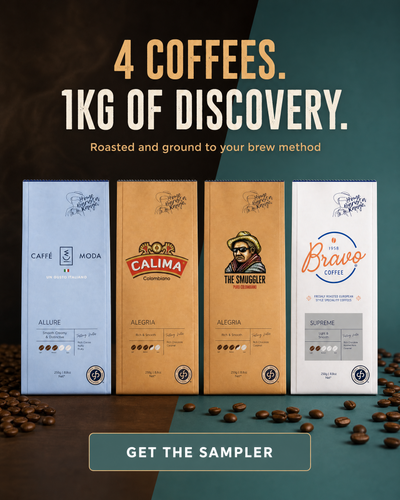
If you are not sure where to start, the sampler pack puts several roasters in one box so you can find yours before committing to a kilo.
Where to start
If you are not sure yet, the sampler is the cheapest way to find out what you actually like before committing to a kilo of it.