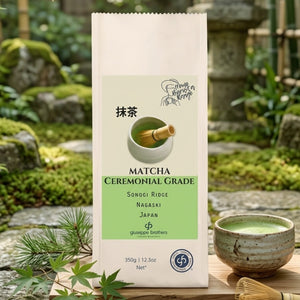
Matcha does contain caffeine, and the honest answer to how much is: less than your coffee, and it arrives differently. Both halves of that matter, because most people asking the question are really asking whether they can switch without losing the morning.
The numbers
Caffeine per serve, roughly:
- Matcha, 2g whisked — 40 to 70mg
- Single espresso — 60 to 80mg
- Double shot flat white — 120 to 160mg
- Steeped green tea — 20 to 30mg
- Black tea — 40 to 50mg
So a bowl of matcha sits between a black tea and a single espresso. A double shot has roughly two to three times as much.
The range on matcha is wide for a reason. You are drinking the whole leaf, so the dose depends entirely on how much powder you used. Two grams is a standard serve; a heaped scoop can easily be four, which doubles it. Ceremonial grade from the first harvest also runs higher in caffeine than culinary grade made from older leaves.
Gram for gram it is stronger than coffee
A frequent confusion: dry matcha powder contains more caffeine by weight than dry coffee beans. That is true, and it is irrelevant. You brew a coffee with 18 to 20g of beans and a matcha with 2g of powder. The serve is what you drink, and the serve is smaller.
Why the same caffeine feels different
This is the part people assume is wishful thinking. It is not.
Matcha plants are shaded for three to four weeks before harvest. Deprived of light, the leaf concentrates L-theanine, an amino acid that crosses the blood-brain barrier and promotes alpha wave activity — the state associated with relaxed alertness rather than stimulation.
L-theanine does not cancel caffeine. It changes its shape. The caffeine spike flattens into a slower onset and a longer, lower curve, which is why people describe matcha as focus without the jitter and without the 2pm collapse. Steeped green tea contains L-theanine too, but you discard most of it with the leaves. Matcha is the ground leaf, so you drink all of it.
Which should you actually drink
- You want the hit — coffee. Nothing matches espresso for speed and force.
- You crash at 2pm — matcha in the morning is worth a fortnight's trial.
- You drink four coffees a day — swapping the afternoon two for matcha cuts your intake without cutting the ritual.
- You are sensitive to caffeine — matcha is gentler, but it is not decaf. If caffeine is genuinely a problem, it is still caffeine.
A practical note on the afternoon
Caffeine has a half life of about five hours. A 3pm coffee still has half its caffeine working at 8pm. A 3pm matcha at 50mg leaves 25mg by evening, which is roughly a cup of black tea. That difference is usually the one people feel at bedtime.
If you want to try it, start with ceremonial grade matcha powder and use 2g, not a heaped scoop. Our guide to making matcha covers the water temperature and the sifting step that decide whether it tastes sweet or bitter.